Program - Munson Healthcare System
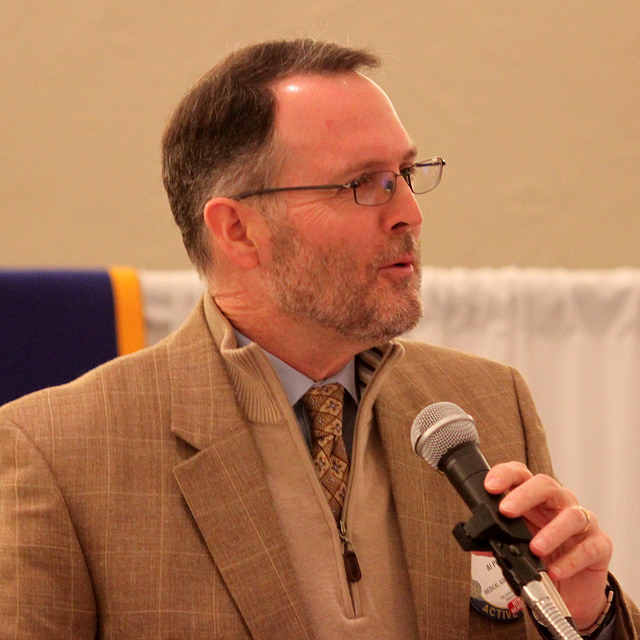 An insider’s look at the future of health care in the Grand Traverse Region spoke yet again to the fact that some of the club’s most insightful programs are presented by its members.
On the eve of its 100th anniversary, Al Pilong, president of Munson Medical Center, and a new Rotarian, provided a sound bill of health with a sweeping overview of the Munson Healthcare System’s regional system of care; addressed health care reform and its potential effects on Munson; and provided Rotarians with a Cowell Family Cancer Center update.
Accompanied by an informative slide presentation and trail of metrics, Al noted that Munson Healthcare’s system encompasses:
• 8 hospitals
• 30 counties
• 53 medical specialties
• 60+ outpatient locations
• 671 beds
• 800+ physicians
• 7,000 employees
• And serves over 520,000 people in Northern Michigan
• 8 hospitals
• 30 counties
• 53 medical specialties
• 60+ outpatient locations
• 671 beds
• 800+ physicians
• 7,000 employees
• And serves over 520,000 people in Northern Michigan
Last year, system-wide, it accounted for:
• 3,200 births
• 31,000 inpatient admissions
• 41,000 surgeries
• 143,000 ER visits
• 900,000 outpatient visits
• $900 million in revenue
• 3,200 births
• 31,000 inpatient admissions
• 41,000 surgeries
• 143,000 ER visits
• 900,000 outpatient visits
• $900 million in revenue
Locally, Al observed that the county’s largest employer is the regional referral center for Northern Michigan, providing:
• 53 medical specialties
• 300+ volunteers
• 391 licensed beds
• 450+ medical staff
• 4,000+ employees
• The only Level II trauma center north of Grand Rapids
• Only neonatal intensive care unit in Northern Michigan
• 53 medical specialties
• 300+ volunteers
• 391 licensed beds
• 450+ medical staff
• 4,000+ employees
• The only Level II trauma center north of Grand Rapids
• Only neonatal intensive care unit in Northern Michigan
Pressure to lower health care costs is the driver behind national health care reform, posited the Munson president. “It’s all about costs,” noting that the hospital’s focus is on lowering in-patient to out-patient ratios, discharging patients to convalesce at home as soon as possible.
Currently the U.S. spends some 60% more than other countries on average for health care, said Al.
However, all that spending is not resulting in significantly improved outcomes.
However, all that spending is not resulting in significantly improved outcomes.
Some 26 countries have greater life expectancies.
As the Boomer generation retires, Medicare growth will soar, he pointed out. Between 2011 and 2030, Baby Boomers will turn 65 at a rate of 10,000 per day. This will result in a spike in Medicare enrollment of from 40M in 2000 to 80M in 2030.
Who’s footing the bill for health care spending?
According to 2012 figures, public spending accounts for $1.2 trillion (47%): $572 billion, Medicare, 22%; $434 billion, Medicaid and CHIP (Children’s Health Insurance Program), 16%; and $231 billion, Other, 9%. Private spending totals $1.4 trillion (53%); $917 billion, payments by private health insurers, 35%; and $328 billion, consumer/out-of-pocket, 12%.
With health care reform, Al explained that the impact on Munson is reflected by declining overall health care costs. “All payer” in-patient admissions are slowing and out-patient visits increasing.
Current Munson annual revenues of over $900 million result from Medicare, 55% and Medicaid, 9%; along with commercial and Priority Health, 17%; Blue Cross, 15%; and self pay, 4%.
In 2020, the revenue mix will grow to Medicare, 58%, and Medicaid, 12%; while commercial and Priority Health will fall to 13%; Blue Cross, 13%; exchanges, 3%; and self pay, 1%.
One of the challenges for Munson he said is a cumulative federal payment shortfall of $165 million over 10 years (2013-2022).
Three significant trends are also underpinning health care reform, explained Al:
Cost
Reimbursement changes and managing costs to offset.
Value
A shift from volume to value and maintaining high-quality care.
A shift from volume to value and maintaining high-quality care.
Relationships/Connections
Partnerships and linkages; managing population health; and care coordination.
Partnerships and linkages; managing population health; and care coordination.
He concluded his presentation with a brief update on construction progress at the Cowell Family Cancer Center,
slated to open in 2016. The $45 million facility will offer diverse and complete cancer services under one roof. Rotary participated in the public philanthropy portion of the campaign with a $500,000 matching Charities’ grant. Some $18.3 million was raised.
slated to open in 2016. The $45 million facility will offer diverse and complete cancer services under one roof. Rotary participated in the public philanthropy portion of the campaign with a $500,000 matching Charities’ grant. Some $18.3 million was raised.
“Thank you for your vision and support,” acknowledged Al.
(President Pilong’s slide data courtesy of Meghan Martin Daigh, Corporate Communications, Munson Healthcare, and a
Rotarian; and Ian Jones, Director, Corporate Communications & Marketing, Munson Healthcare.)
Rotarian; and Ian Jones, Director, Corporate Communications & Marketing, Munson Healthcare.)