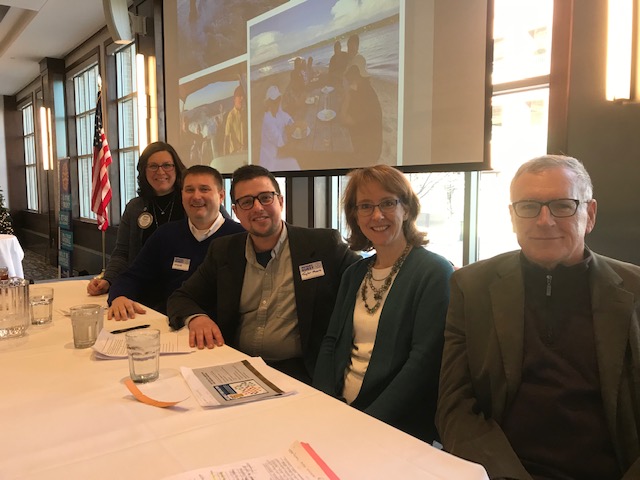
Becky Ewing introduced our program for the week. Following on the heels of last week’s announcement of almost one million dollars in grants, which amounts to nearly $60,000,000 over the lifespan of Rotary Charities granting programs, two of the grantees were asked to present. Each featured new aspects to the granting programs: Assets for Thriving Communities and Systems Change Accelerator. First up was Taylor Moore Manager of Food Rescue of Goodwill Industries.
Moore introduced Food Rescue partners in what he referenced as The Healthy Food Access Hub. Along with himself was Mary Clulo, Director of Treasury & Tax at Munson Health Care and Chair of the Operating Committee for the Northwest Food Coalition and Fred Laughlin, Former Director of the Great Lakes Culinary Institute at NMC and current Board Member of the new Long Lake Teaching Kitchen & Education Center.
These three programs present a partnership geared toward moving more than shelf stock preserved food to pantries. They are working on advancing distribution networks for fresh produce from both farm and restaurants to pantries. Also is the need for advancing education as Laughlin spoke to briefly in his comments focusing on the development of the teaching facility and the goal in assisting individuals to learn how best to utilize fresh and nutritious foodstuffs in daily diets.
It starts with the Northwest Food Coalition whose mission is to meet the hunger needs of residents of the five-county area while continuing to address the greater issues of poverty. Since their inception, the group now includes 34 pantries, 8 baby pantries and 26 meal sites in 6 counties to address those hunger needs. They make a difference in the lives of those people who have needs and offer fellowship and caring to their neighbors.
Working hand in hand with Goodwill Industries Food Rescue they have established the key mapping of distribution and access to deliver fresh food and delivering nutrition rich dietary options and building capacity to service the pantries and their constituents in this way.
An additional piece is an educational component and teaching kitchen to teach individuals &pantry workers how to cook, shopping coaches etc. Bringing all these elements together is the goal of the use of the funds of these current Rotary funds.
The next speaker, Stephen Hensler from the Cerulean Center, spoke of the connection of the professional and the citizen scientist. This grant is aimed at targeting root causes of complex problems.
Hensler is the Executive Director of the Cerulean Center whose purpose is to advance understanding of the Great Lakes ecosystem. Working with both Inland Seas and the Grand Traverse Land Conservancy, the aim of this grant is to use citizen science to better understand invasive species, climate change, and end of life piping issues among many complex problems and to track them in ways that can take citizen science and put it to the rigors of established scientific protocol.
This collaboration opens science up and we, here in Traverse, with the Discovery Center and Pier have a unique location and opportunity to explore the collaborative opportunities even further.
It is clear that these two projects are only the beginning of how the new collaborative watch that Rotary Charities is placing on its granting may bear new fruit. As Ewing & co-Worker Freya Bradford noted – Where once Rotary Charities granted money to one organization, now one grant will touch [in this case] 65 organizations.
Pretty damn impressive, huh?